
Publication in Journal of International Business Policy 8 January 2026
Political shocks, both geopolitical and domestic, are often described as external “events” that disrupt markets. For firms, however, the disruption rarely arrives as a single, direct impact. It is translated step by step through institutions, policy instruments, and societal pressures before it becomes a concrete managerial problem: a compliance obligation, a reputational risk, a sourcing constraint, a licensing delay, a financing barrier, or a demand shock.
A recent publication by Harald Puhr, Assistant Professor of International Management at University of Innsbruck, together with April Knill and Daniel Andrews draws on a systematic review of 159 studies to clarify this translation process and to propose an integrative model of how shocks transmit to firm behavior. The central argument is straightforward but powerful: institutions are the transmission belt. They convert political volatility into the rules, expectations, and constraints that companies must interpret and act upon.
Andrews, D. S., Puhr, H., & Knill, A. (2026). Transmission of geopolitical shocks to firm behavior: a synthesis and integrative model. Journal of International Business Policy. https://doi.org/10.1057/s42214-025-00232-8.
This publication contributes to VALPOP’s core agenda to understand how governance outcomes are shaped by institutional configurations and actor relationships and to translate that understanding into greater transparency, stronger accountability, and improved civic participation in protecting public goods. The paper’s “transmission lens” complements that agenda by making the pathways of influence more legible and analyzable.
Why the mechanism matters
Two countries can experience the same shock and see different corporate outcomes. Two firms in the same sector can face the same formal rule and respond differently. These divergences are not noise; they are often produced by differences in transmission mechanisms:
- What the state formalizes (or does not formalize)
- How ambiguity is communicated and enforced
- How narratives, media attention, and reputational pressure shape perceived risk
- Whether firms can anticipate and adapt or are forced into reactive responses
Understanding transmission mechanisms improves analytical precision. It also supports better governance design: if policymakers or oversight actors know which mechanisms drive which types of corporate response, they can choose instruments that are more effective, more transparent, and easier to audit.
Explicit vs implicit transmission: The model in plain language
A key contribution of the paper is distinguishing between explicit and implicit transmission mechanisms. Explicit mechanisms are formal, codified, and enforceable. They include instruments such as sanctions, export controls, investment restrictions, licensing regimes, and regulatory amendments. These tools can create immediate, measurable constraints and compliance requirements.
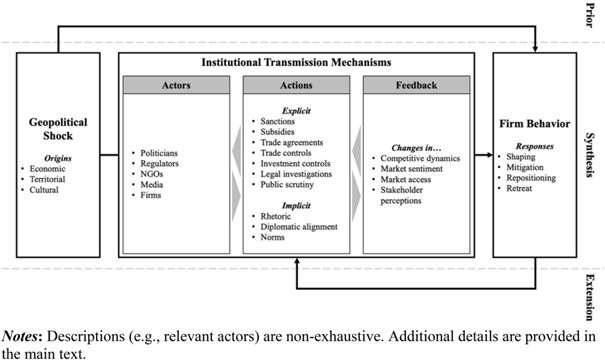
Image: Andrews, Puhr, & Knill, 2026
Implicit mechanisms are informal, diffuse, and often non-binding yet consequential. They include reputational pressure, public discourse, elite signals, stakeholder activism, market expectations, policy uncertainty, and “soft law” norms. These mechanisms can influence firm behavior even without new legislation and they can either amplify or dilute the effect of explicit rules.
Crucially, the mechanisms are not independent. Implicit mechanisms can accelerate formal policy adoption, affect how rules are interpreted and enforced, or prompt firms to “self-sanction” beyond legal requirements. Conversely, weak narratives or inconsistent signaling can undermine formal tools.
Connecting the model to VALPOP’s objectives
VALPOP’s focus on transparency, accountability, and civic participation benefits from this model in several concrete ways.
Transparency: making pathways of influence visible
VALPOP aims to increase transparency about governance structures and the ties among actors that shape access to public goods. The transmission model provides a disciplined way to document how influence travels:
- Explicit mechanisms map to formal decisions, legal texts, enforcement actions, and administrative discretion.
- Implicit mechanisms map to narratives, stakeholder pressures, reputational dynamics, and uncertainty signals.
For VALPOP, this distinction is actionable: transparency initiatives can be designed to illuminate both channels, not just the codified one. In many contexts, the implicit channel determines whether formal rules achieve their intended effect.
Accountability: improving auditability and control mechanisms
Explicit mechanisms are typically auditable (they have documents, dates, authorities, and enforcement records). Implicit mechanisms often lead to accountability gaps because they operate through diffuse pressure, ambiguity, and informal expectations.
The model suggests an accountability agenda that aligns with VALPOP:
- Track not only what rules exist, but how expectations are communicated and enforced.
- Identify when “informal enforcement” substitutes for transparent rulemaking.
- Pinpoint where ambiguity enables inconsistent application across firms or sectors.
This strengthens oversight by turning “soft influence” into observable indicators (e.g., changes in disclosures, sudden shifts in compliance postures, coordinated industry guidance, or reputational campaigns).
Civic participation: Clarifying leverage points for society
VALPOP emphasizes civic participation in protecting public goods. The transmission model shows that civil society influence often enters through the implicit channel (discourse, activism, reputational accountability) and can shape outcomes even before formal policy changes occur. But it also highlights limitations:
- If implicit pressures are uneven or visibility is asymmetric, outcomes can be distorted.
- If firms respond primarily to reputational risk rather than public-good metrics, actions may be symbolic.
For VALPOP, this underscores the value of tools and frameworks that improve the quality of public signals (i.e., credible information, transparent data, and clear accountability pathways) so civic pressure is better targeted and less prone to manipulation.