
VALPOP session at the Annual Meeting of the Academy of Management (AOM) 2026
Why should society care about interactions between firms and the state regarding access and allocation of public goods? And why are accountability and transparency of these interactions important? These were among the key questions addressed in the VALPOP session, held on 4 August at the Annual Meeting of the Academy of Management (AOM) 2026.
As Harald Puhr highlighted in the opening presentation, society should care about how interactions between firms and the state are managed because a lack of transparency and accountability can erode public trust in both business and government. Such erosion of trust can, in turn, contribute to greater populism and political polarisation.
The panel explored how accountability becomes difficult when influence is hidden through networks and low-visibility intermediaries. By combining research and policy perspectives, the session aimed to clarify when and how opacity occurs, which actors matter and what governance solutions are feasible.
Panel Symposium: Accountability and Transparency in Firm-State Interactions
Panellists:
Harald Puhr, University of Amsterdam
Bruce Freed, The Center for Political Accountability
Sinziana Dorobantu, NYU Stern School of Business
Thomaz Teodorovicz, University of St.Gallen
Tony L. He, Rutgers Business School
Organisers:
Laurenz Tinhof, WU Vienna
Rodrigo Luna, Copenhagen Business School
Key takeaways:
Opacity occurs when influence is hidden or denied
- Bruce Freed from the Center for Political Accountability documented the scale of corporate political funding through intermediaries such as partisan governors’ associations, state legislative campaign committees, and attorneys general associations. In 2024, 527 US committees received nearly $200 million from public companies and trade associations. These contributions are only partially disclosed (Source: Center for Political Accountability).
- Sinziana Dorobantu from NYU Stern School of Business highlighted that foreign firms have easier access to the relevant decision-makers in societies with open information networks and a strong rule of law. In countries with closed networks and a weak rule of law, foreign firms might be systematically excluded from access to public goods.
The power of intermediate actors: gatekeepers and appointed staff
- Tony L. He from Rutgers Business School argued that research on political connections has traditionally looked upward at presidents, ministers, legislators, and party leaders, while paying less attention to aides, advisors, chiefs of staff, party operatives, and administrative personnel. Although these actors may lack formal allocative authority, they can function as gatekeepers to decision-makers, brokers between firms and political actors, sources of competitively relevant information, and participants in shaping agendas, requirements, and the terms of access.
- Thomaz Teodorovicz from University of St.Gallen pointed out that a broader structure of appointed staff is often needed to convert political connections into returns for firms. Two types of staff are particularly important: appointees with accumulated bureaucratic experience, who possess tacit, hard-to-transfer knowledge of how procedures actually work in practice, and appointees in managerial positions with real allocative authority. Returns to connected firms are highest when both types are present.
Governance solutions: building trust through transparency and counterstrategies
- Bruce Freed presented the CPA-Zicklin Index of Corporate Political Disclosure and Accountability, a benchmarking instrument that evaluates companies on their disclosure and governance of political spending.
- Thomaz Teodorovicz highlighted how research into the strategies politicians use to capture public goods, and the resources required to do so, can help regulators identify and develop effective counterstrategies.
The session underscored the importance of looking beyond formal decision-makers and visible forms of influence. Understanding the networks, intermediaries, and institutional structures through which access to public goods is shaped is essential for developing effective governance mechanisms and ultimately for strengthening transparency, accountability, and public trust.
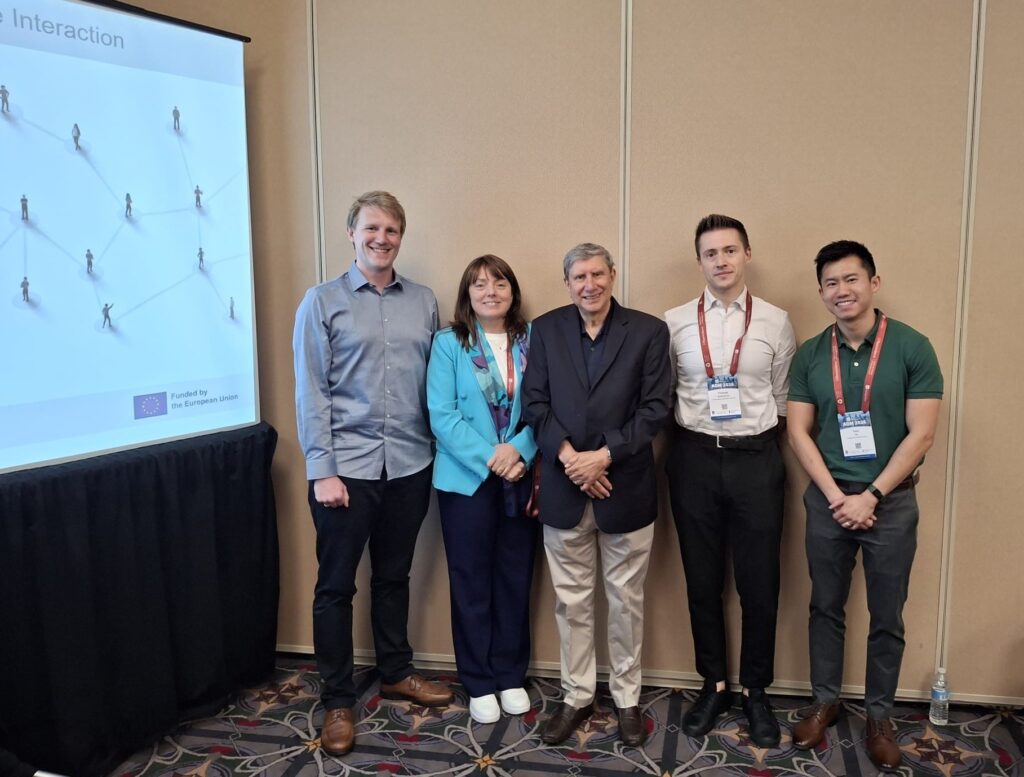
Panellists (from the left): Harald Puhr, Assistant Professor at University of Amsterdam; Sinziana Dorobantu, Assistant Professor at NYU Stern School of Business; Bruce Freed, President of Center for Political Accountability; Thomaz Teodorovicz, Assistant Professor at University of St.Gallen and Tony L. He, Assistant Professor at Rutgers Business School.