
VALPOP had a strong presence at this year’s Academy of International Business (AIB) conference, held in Manchester from 29 June to 3 July.
Project activities included presentations on how populism and geopolitical developments affect and direct international business, as well as a special VALPOP panel on the role of multinational corporations in contributing to public goods. Together, these activities highlighted the project’s ongoing contributions to advancing research on the complex relationship between business, politics and society.
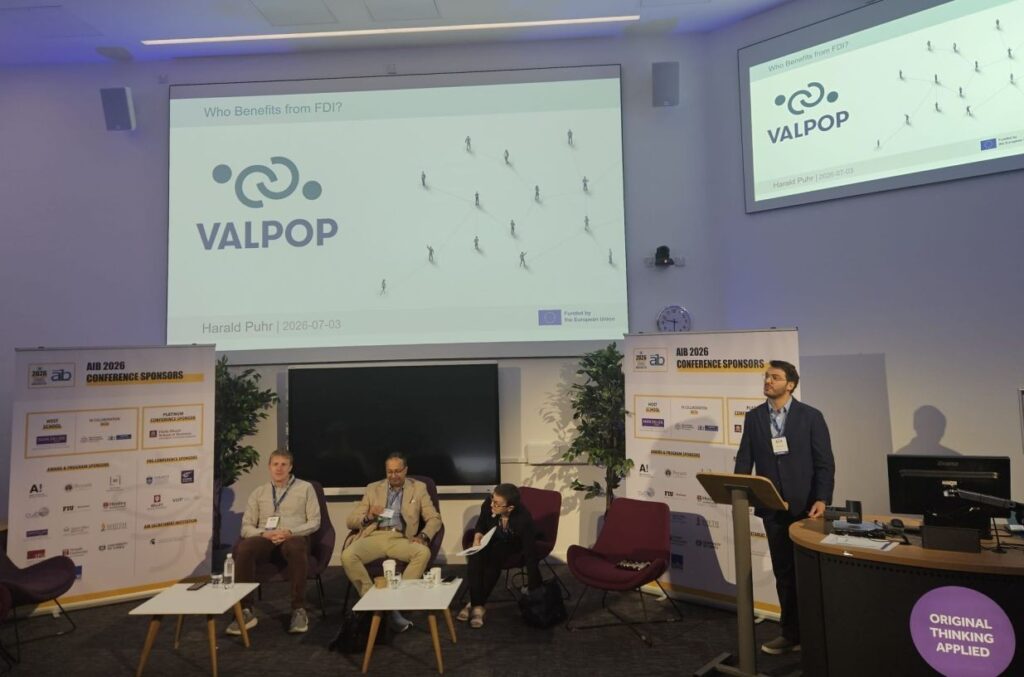
The VALPOP session was moderated by Rodrigo Luna, Copenhagen Business School
The VALPOP panel session, “Who Benefits from FDI? Public Goods Contributions of MNEs”, discussed how multinational enterprise (MNE) activities and foreign direct investment (FDI) are shaping public goods and access to them.
- Chairs:
- Harald Puhr, University of Amsterdam
- Laurenz Tinhof, WU Vienna
- Rodrigo Luna, Copenhagen Business School
- Panelists:
- Axèle Giroud, University of Manchester
- Tazeeb Rajwani, University of Surrey
- Harald Puhr, University of Amsterdam
Abstract: Populism is a phenomenon in which political leaders employ rhetoric that emphasizes a claim to speak for the common people and delegitimizes actors whose actions are not aligned with this agenda. This study examines how and when country-leader populism in a target country affects firms’ inward investment mode strategies. Drawing on a legitimacy-based framework, we argue that foreign firms prefer greenfield investments over acquisitions when investing in countries governed by populist leaders. Greenfield investments confer pragmatic legitimacy on firms through their positive employment effects and limited national security concerns, thereby aligning with and serving the populist leader’s rhetoric and agenda. We expect this effect to be stronger in host countries experiencing economic downturns and in home-host country dyads with higher political or economic dissent. We further suggest that this effect is more pronounced for larger firms and less (more) for firms with previous greenfield projects (acquisitions) under the populist leader. Analyzing a dataset of foreign investments into the European Union, we find support for most of our hypotheses. Interestingly, prior acquisitions do not affect this relationship and previous greenfield investments actually further strengthen the main relationship. Collectively, our results shed light on the role of populism in foreign firms’ investment strategies and highlight the mechanism of pragmatic legitimacy in dealings with populist country leaders.
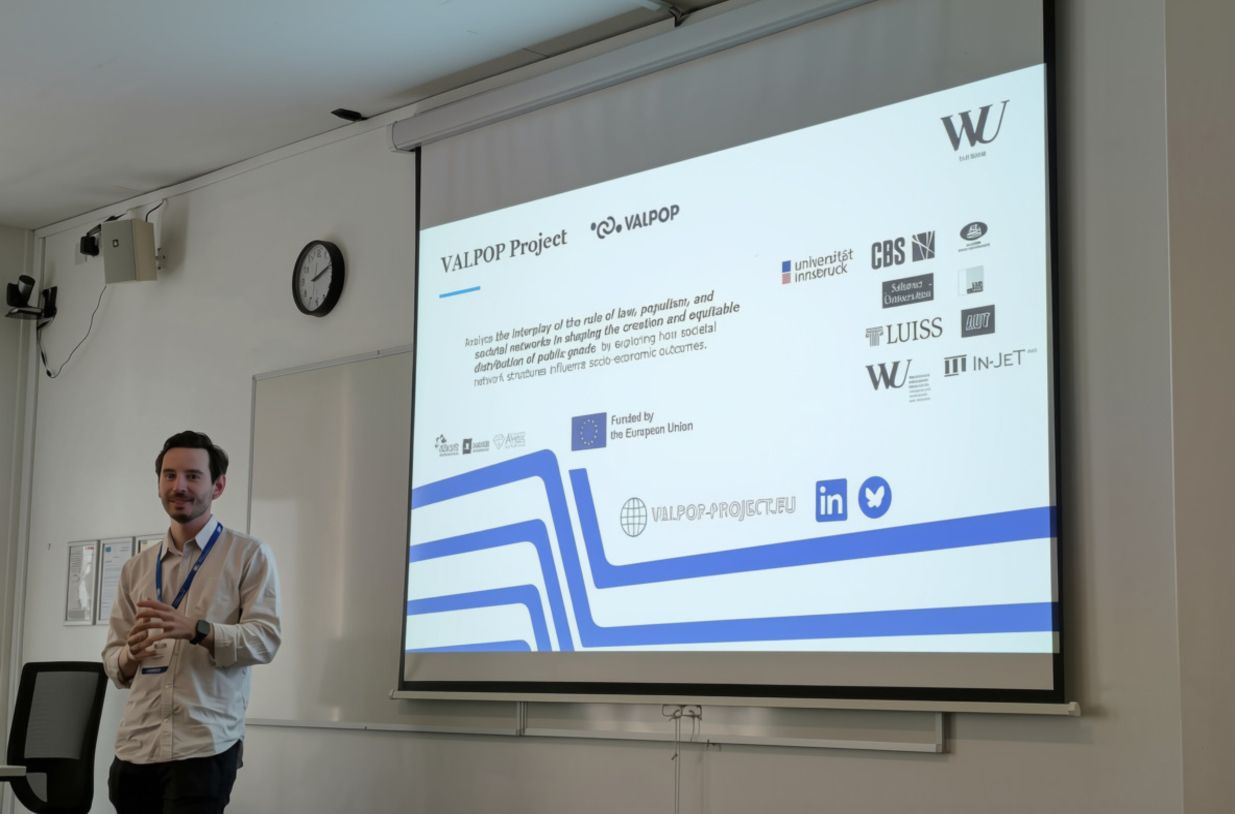
Michael Wolfesberger, WU Vienna
- Panelists: Christopher A. Hartwell, ZHAW School of Management and Law, Harald Puhr, University of Amsterdam; Jing Li, Simon Fraser University; Kristin Brandl, Copenhagen Business School / University of Victoria
Abstract: Today, many public-private partnerships (PPPs) are formed with a foreign MNE as the private partner with the aim of delivering a public good or service cost-efficiently. PPPs have become part of geopolitically motivated campaigns such as China’s Belt and Road Initiative which targets strategic infrastructure assets. However, the PPP literature has debated the formation, performance and value distribution of PPPs mostly at the national level, overlooking international dynamics. Our study addresses this gap by conducting a multidisciplinary literature review on PPPs, employing bibliometric analysis and a theory-focused qualitative review to identify the key questions and theories in the field. We then integrate this with IB theory, notably drawing on the Foreign Direct Investment (FDI) literature, and propose a stakeholder-centric research agenda on cross-border PPPs. Future research should especially explore how the MNE’s home government influences PPP outcomes, and also examine host institutions and politics, home-host government relationships, and the roles of civil society. It should also consider which strategies (market and non-market) distinguish successful MNEs in the PPP context.